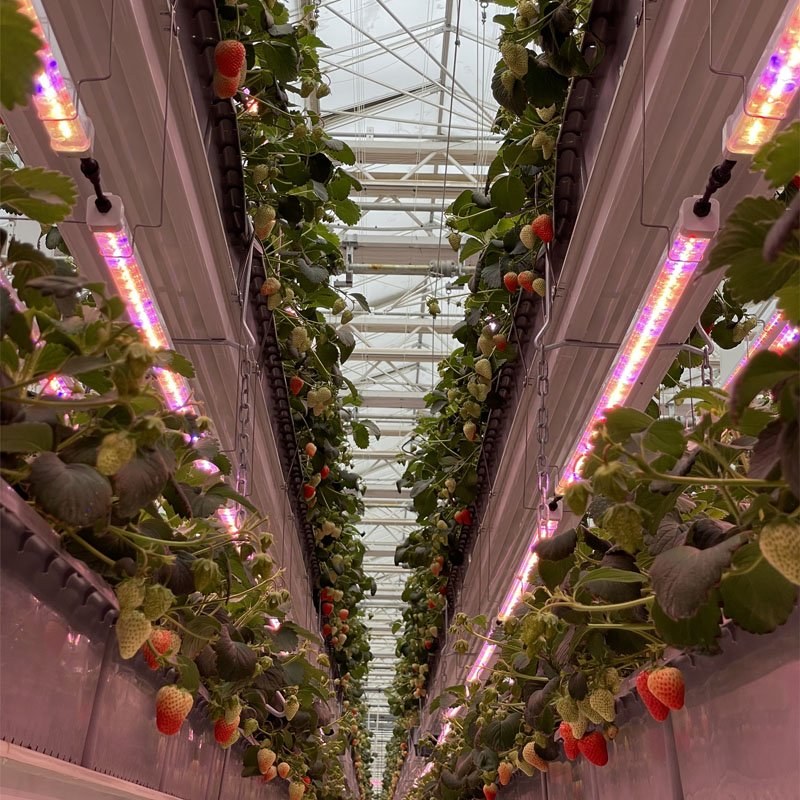
Indoor strawberry production has officially crossed into commercial supermarket aisles. On October 29, 2026, the Tokyo District Court dismissed all patent claims by vertical farm operator Oishii Farm against Japanese agtech developer MD-Farm over continuous flowering methods. The court also found Oishii negligent in issuing statements disparaging MD-Farm under Japan’s Unfair Competition Prevention Act, ordering 2.2 million yen in damages.
Simultaneously, Oishii announced a major retail expansion reaching more than 500 grocery locations by late 2026. This dual reality highlights an essential turning point for controlled environment agriculture. The era where proprietary plant recipes served as valuation shields has yielded to supermarket shelf battles, where volume reliability, unit economics, and equipment integration determine commercial survival.
For growers and facility developers, this courtroom outcome alongside grocery expansion shows how high-value horticulture actually scales. Commercial success no longer hinges on guarding biological secrets, but on deploying dependable photoperiod management, automated climate control, and high-density racking capable of delivering repeatable margins at supermarket scale.
The Legal Reckoning Over Continuous Flowering Technology
The Tokyo District Court case, filed on December 20, 2024, centered on Japanese Patent No. 7551158, entitled “Method for Cultivating Strawberry.” The patent covers a critical technique in controlled environment berry farming: managing environmental parameters to induce continuous flowering and year-round fruiting. Oishii asserted that MD-Farm founder Yuki Matsuda completed the invention during his earlier association with Oishii, demanding assignment of the patent rights.
The court systematically rejected those claims. Following multi-year proceedings, the judicial panel ruled there were insufficient factual grounds to conclude Matsuda developed the method while employed by Oishii, or that technical data had been misappropriated. Granting MD-Farm’s counterclaims under Article 2 of the Unfair Competition Prevention Act, the court ordered Oishii to pay 2.2 million yen in damages and cease disseminating the statements.
This ruling sets an essential precedent for agtech engineering. Foundational methodologies—such as vapor pressure deficit steering and tailored LED spectrum recipes to sustain reproductive phases—are rarely enforceable as proprietary monopolies. Instead, competitive advantage is governed by how effectively operators translate cultivation science into physical infrastructure via high-efficacy indoor grow light systems and precise irrigation hardware.
Supermarket Scale: Doubling Distribution to 500 Outlets
While legal proceedings concluded in Tokyo, commercial distribution accelerated across North America. Oishii confirmed supply agreements placing its berries across major grocery chains, entering mass retail. The rollout brings products into 78 Walmart locations in New Jersey and Pennsylvania, alongside 84 The Fresh Market stores across five southeastern states, including first-time entry into North Carolina, South Carolina, Louisiana, Mississippi, and Alabama.
The network is reinforced by 30 Giant Food stores across Maryland and Virginia, plus 34 additional Sprouts Farmers Market stores across Florida and Georgia. To service this footprint, Oishii introduced tiered commercial grades driven by the high-volume Nikko Berry format packaged for mainstream price points. The expansion proves controlled environment produce can move beyond metropolitan boutiques when volume targets are met.
Meeting supply commitments across hundreds of supermarkets requires industrial redundancy rather than artisanal methods. Retail agreements enforce strict volume fulfillment clauses and stockout penalties. Operating at this scale demands industrial modular growing facilities that eliminate microclimatic variation across every tier of the crop canopy.
The Physics of Industrial Strawberry Canopies
Scaling indoor berry production introduces biophysical constraints that leafy green growers rarely face. Unlike vegetative crops, strawberries require multi-stage spectral management, transitioning from vegetative growth to bud differentiation and heavy carbohydrate translocation during fruit fill. Oishii’s facility in Phillipsburg, New Jersey, was engineered to address these thermodynamic and aerodynamic bottlenecks across stacked vertical tiers.
Maintaining high Brix sugar content and consistent firmness without triggering fungal pathogens requires precise airflow management around delicate clusters. Air speeds must stay within strict thresholds to ensure transpiration without causing mechanical stress to blossoms. Furthermore, multi-tier strawberry racks require photosynthetic photon flux densities between 200 and 350 micromoles per square meter per second, delivered with minimal radiative heat transfer to prevent crown overheating.
These rigid physiology requirements explain why modern growers rely heavily on robust environmental control systems that synchronize real-time dehumidification, carbon dioxide injection, and root-zone fertigation cycles. Without automated equipment holding setpoints stable across four seasons, yield projections collapse under biological variability regardless of patent ownership.
Why Hardware Integration Trumps Biological Exclusivity
The convergence of Oishii’s patent defeat and its 500-store distribution network clarifies the shifting economics of vertical farming. During the previous venture cycle, operators claimed that closed software algorithms and proprietary biology justified tech-like valuations. In practice, biological processes cannot be permanently locked inside corporate silos; continuous flowering principles are accessible to any qualified agronomic team.
The operational moat has shifted entirely to execution efficiency: lowering capital expenditure per linear meter of canopy, maximizing photon efficacy, and reducing kilowatt-hour consumption per kilogram of marketable fruit. Supermarket produce buyers care about on-time pallet deliveries, uniform berry sizing, consistent sugar-to-acid ratios, and price predictability. Equipment that delivers predictable microclimates while lowering operating overhead determines who keeps shelf space.
As commercial indoor strawberry farming expands across North America, Europe, and Asia, the industry winners will be operators who treat facilities as precision manufacturing cleanrooms. Standardized modular hardware, industrial lighting, and reliable multi-parameter climate control have proven far more durable than legal assertions of exclusivity. The future of controlled environment agriculture belongs to scalable, verifiable hardware integration.