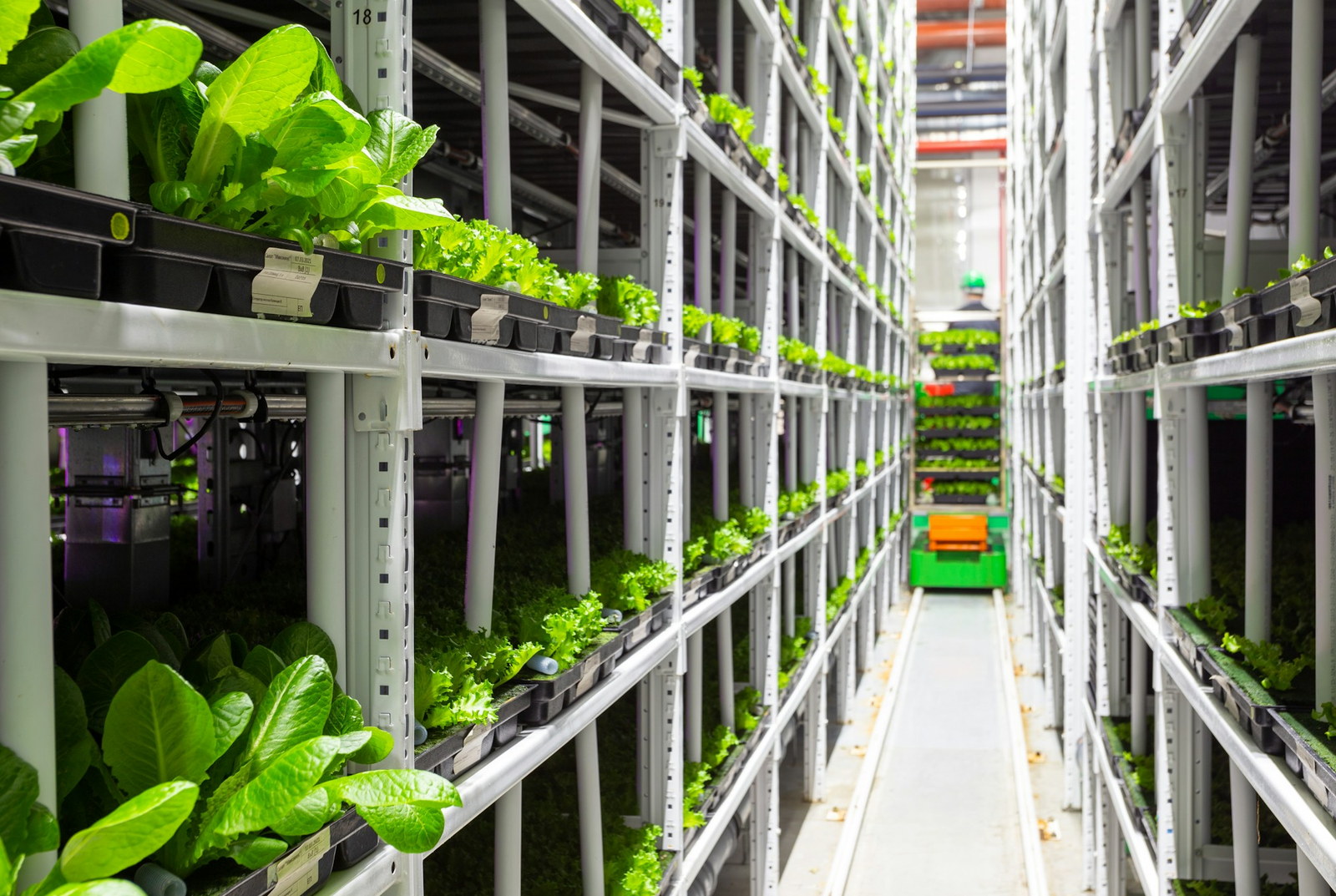
Lettuce weighing 500 grams once looked like an achievement to N.thing. The company, established in 2014, had grown it, and by the logic of yield per square metre the result was good. Customers wanted something else: heads of 80 to 120 grams, small enough to seal in a single pack.
That correction is the subject here. It marks the point where a vertical farm stops selling biomass and starts selling a plant built to a purchaser’s specification, a shift the company calls the agricultural foundry.
The evidence sits in two figures: approximately 1,767 completed cultivation cycles and more than 50 cultivation recipes derived from them.
A weight target is not a specification
Weight is the easiest thing to measure and the hardest to differentiate. Two heads of lettuce can weigh the same and differ in leaf thickness or in the ratio of compounds a buyer cares about. Open-field production cannot separate those variables, because the field sets them.
The 500-gram lettuce illustrated the gap. The farm had optimized for a number its customers did not buy. The head that fits a single pack, at 80 to 120 grams, is a packaging constraint expressed as an agronomic one.
Kim Hye-yeon, the company’s representative, summarized the lesson in three words: “As the customer desires.” The specification came from outside the grow room, and the grow room had to be rebuilt around it.
What 1,767 cycles make possible
One cycle is one complete growth period, sowing to harvest. Across roughly 1,767 of them, the same crops have been held under recorded conditions repeatedly and the outcomes compared.
The comparison the company offers is temporal. Producing the same data in open fields at one crop a year would have taken more than 1,700 years. At two to three leafy crops a year, it would still take an estimated 500 to 600 years.
Compressed time is the actual product of a controlled environment. A recipe that fails can be revised and retested within a season instead of a decade. The output is more than 50 cultivation recipes: documented guidelines for setting the growth environment of a given crop.
Control is the layer that carries the spec
The mechanism is not exotic. Adjusting cultivation conditions such as light, temperature, humidity, and nutrients changes the components of the plant. Kim compared it to muscle developing under exercise: the stimulus determines the response.
What makes this commercially useful is the shift from adjusting to holding. A recipe is only a specification if the environment can be reproduced on the next cycle, in the next unit, and later in another building. That puts weight on the environmental control layer that holds setpoints stable across a growth period, and on the lighting schedules that define the light condition written into a recipe.
Container construction is what makes the unit repeatable. N.thing developed its CUBE vertical farm in 2017, installing cultivation facilities inside containers. It operates 28 cultivation units at its direct-operated farm in Icheon, and the system has been applied to 26 domestic and international farms. A standardized container-based cultivation unit is easier to specify and duplicate than a building.
The commercial record so far is narrow and concrete: cultivation facilities for ginseng and tobacco research supplied to KT&G, and facilities for high-quality strawberry seedling production supplied to the Rural Development Administration’s National Institute of Horticultural and Herbal Science. Both are buyers paying for a defined plant rather than for volume.
Measured composition, then a foundry model
Composition becomes a specification only when someone other than the grower can measure it. From 2021 to 2024, N.thing took part in the Gyeongbuk Industrial Hemp Regulatory Free Special Zone Pilot Project and an R&D task run by the Ministry of Agriculture, Food and Rural Affairs.
Over more than 15 cultivation cycles there, the team analyzed how components changed by growth stage and by light type, and worked on varieties, cultivation periods, nutrient solutions, and light conditions. An accredited testing institution confirmed a CBD content of 9.72%. Average cultivation period fell by approximately 19%, from 101.5 days to 82.4 days.
A regulated crop forced component measurement through an external laboratory, and the result held: the difference between asserting a composition and being able to certify it.
The stated business model follows the same logic. A biotech company or research institution specifies target components and varieties, the farm writes the recipe and produces to it, and feasibility is verified in small-scale production before a transition to mass production. Training AI on accumulated cycle data, so that optimal recipes can be derived without manual testing, is the next step named.
For equipment buyers the judgment is blunt. A farm specified only by yield per square metre is bought as a volume machine and will be compared on cost per unit of volume. A farm specified by reproducibility, meaning setpoint stability, sensor placement that survives a cycle, and the ability to rerun a recipe and land inside tolerance, is bought as a specification supplier and competes on something else. The second configuration costs more to instrument and is harder to commission. It is also the only one that can quote a composition target and defend that number cycle after cycle.