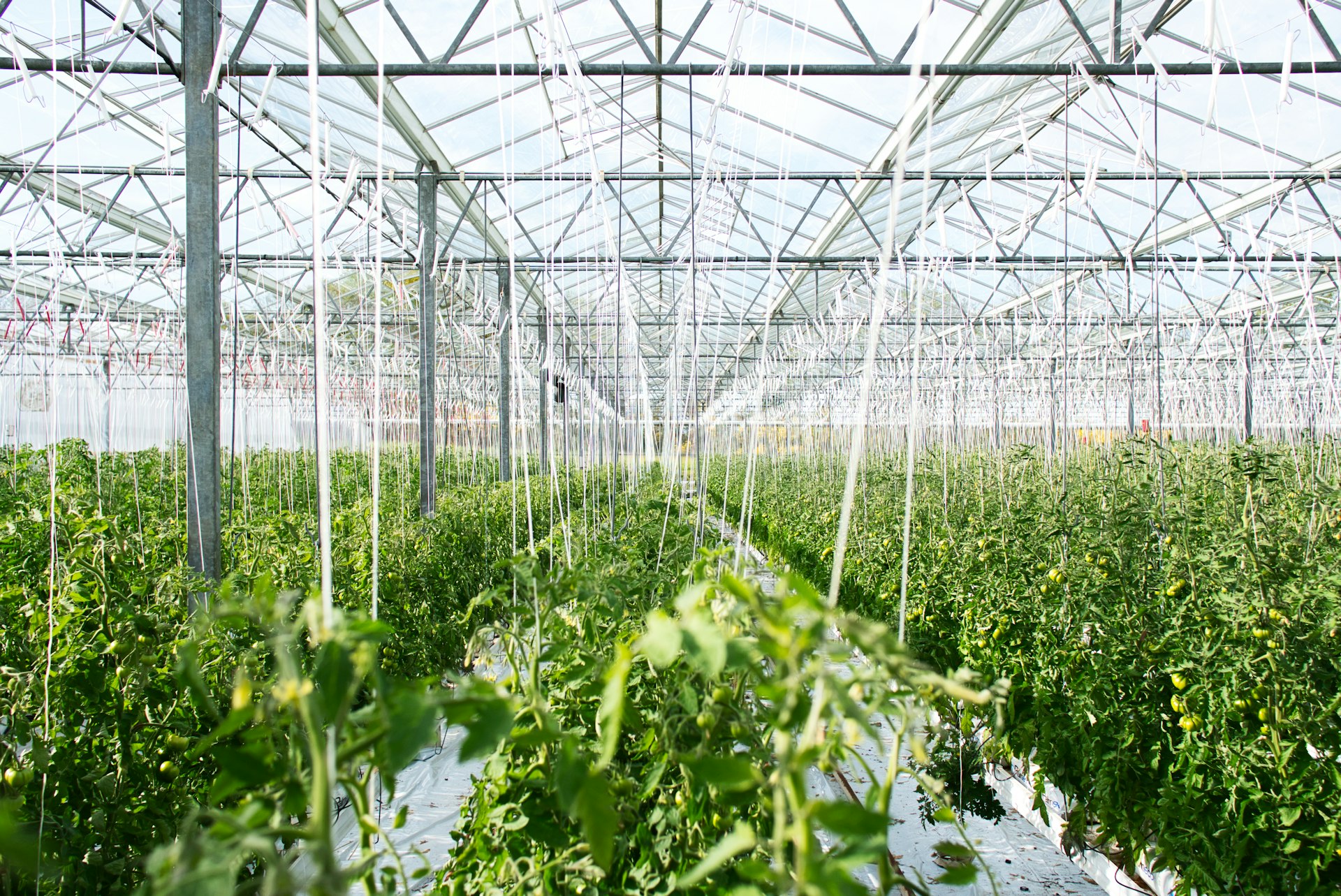
For the past five years, greenhouse AI meant dashboards. Software that watched your climate data, flagged anomalies, and suggested setpoints — while a human grower still made every final call.
That era ended this month.
The deal
Amsterdam-based Source.ag has acquired Optimal, a London startup whose AI doesn't advise on greenhouse climate — it directly controls it. Heating, ventilation, screens, lighting, CO₂ dosing and irrigation, all executed by the system in real time.
The performance data behind the acquisition is what matters:
- +13% yield and -27% energy consumption in Dutch commercial greenhouse trials, benchmarked against top-tier Dutch growers
- Already operating commercially in Canada
- First joint autonomous deployments scheduled for this winter across Europe and North America
Source.ag brings the distribution: its software already runs in 500+ greenhouses across 25 countries, supporting roughly €2.5 billion in annual tomato, pepper and cucumber production, and serving 13 of the world's 25 largest high-tech growers.
Why the industry needed this
The constraint on global greenhouse expansion has never been glass, steel or capital. It's people.
A master grower with 20 years of crop intuition is the scarcest input in high-tech horticulture. Every major producing region — the Netherlands, Canada, Mexico, the Gulf, East Asia — reports the same bottleneck: greenhouse acreage is growing faster than the supply of people qualified to run it.
Decision-support software helped, but it still required an expert in the loop. Direct autonomous control removes that dependency. One strong grower can now supervise many hectares remotely, with the AI handling second-by-second execution.
Dutch grower Agro Care — one of Europe's largest — has already said publicly it intends to be among the first adopters.
What it means for the supply chain
Three implications we are watching closely:
1. AI control becomes a standard layer in new builds. Within a few years, "autonomous climate control" will be specified in greenhouse RFPs the way LED lighting and energy screens are today. Integrators who can package AI control + lighting + climate hardware into a single validated system will hold the advantage.
2. Expect consolidation among the incumbents. The climate computer establishment — Priva, Hoogendoorn and peers — now faces a credible software-first challenger with direct control proven in commercial operation. Acquisitions or fast-follow product launches are likely.
3. Emerging markets get a shortcut. For regions with capital but no grower base — the Gulf, Southeast Asia, parts of Africa — autonomous control lowers the single biggest barrier to entry: agronomic expertise. A well-instrumented greenhouse in Riyadh or Johor can now borrow the accumulated intuition of Dutch master growers, encoded in software.
The bigger picture
The skilled grower shortage is not temporary. It is demographic and structural. That makes this acquisition less a tech story than a labor story — and labor stories are what drive capital allocation in this industry.
The question for greenhouse operators is no longer whether AI will run parts of their facility. It's which parts, with which vendor, and how soon.
Sources:
- Fruitnet/Eurofruit: Source.ag acquires UK AI startup Optimal (Oct 9, 2026)
- AgFunder: AgriFood Signals weekly roundup (Oct 15, 2026)
What this means for growers
Autonomous control only delivers its yield and energy gains if the hardware underneath can be driven precisely. That is the layer we work on at Regulus: the Green-X environmental control platform integrates climate, CO2, irrigation, and lighting into one system that supervisory AI can actually command – sensors, device stations, and light control in a single loop.